

Why Saving Hospitality Will Save the Wine Industry
Uncovering the Most Anti-Mainstream Restaurant in Madrid

If the future of wine depends on anything beyond climate change and the market’s health, it depends on hospitality.
Not trends. Not packaging. Not even terroir.
It depends on who is pouring the wine, how it is poured and talked about, and whether that moment creates connection or indifference.


This is why this article brings us to La Capa, a casa de comidas (a “food house”, not a wine bar) in Madrid everyone caring for wine should experience at least once.
Their mantra is simple: “If we could do it, would we? Then let’s do it.”
If La Capa were in Brooklyn, the average check would easily be $90 per person. Instead, their weekend menu costs €22. Entrées hover around €15. And they also happen to offer the cheapest glass of natural wine in Madrid: €3 if you drink the house red or white from a porrón.
At first glance, La Capa looks like an anachronism. A 1960s restaurant that has intentionally preserved its original décor, untrendy and unapotetically vintage. Located in Carabanchel, a working-class neighborhood on the outskirts of Madrid. According to one of the owners, Arturo, this area is one of the few places in Madrid left where you can still start a business “without absurd investment costs.”
For what I can tell from our two-hour-long interview, Arturo is one of those no-BS people. If he likes you, he will wide open the door to his house, all the way straight into the kitchen. And that’s essentially what his restaurant, La Capa, is about.
This is the kind of story that used to give me FOMO when I wasn’t living in Spain. In fact, I’m probably the last Spanish writer still swooning over this project to write about them. In their season and a half of being open, every major food and travel publication in Spain has already covered them.
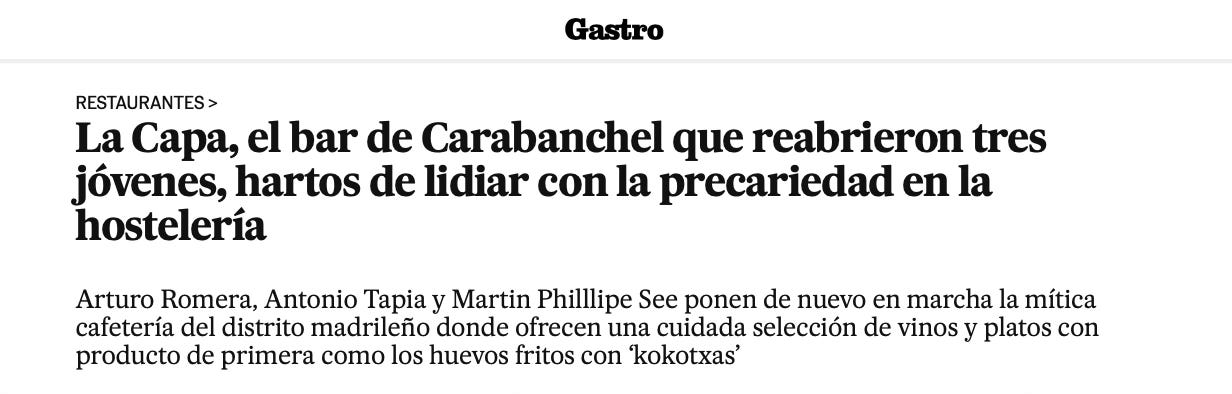
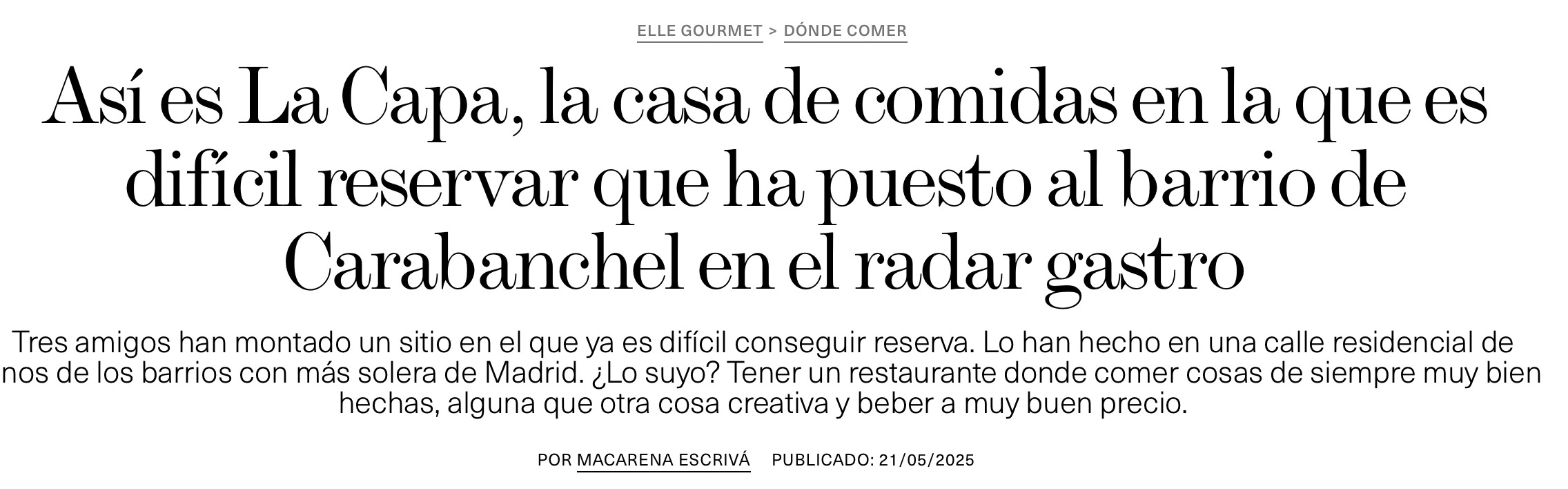

But I am the first one to tell their story in English. My dear little English-readers, you’re welcome.
Albeit this piece doesn’t intend to be a straightforward restaurant review urging you to hop on the next flight to Madrid to come sit at their long shared communal tables (even though you should).


The humans, the vision and the values behind La Capa
The seasonal locally-sourced food speaks for itself. It doesn’t need a fluffy article hyping it up. The traditional-meets-fusion kitchen menu, rotating resident chefs, and an unparalleled wine program are already a flex on themselves.
What is also a flex is building such a successful business model from scratch between three childhood friends withtout, at first glance, any conventional business mindset. The madrileños Arturo Romera and Antonio Tapia (Piru) and Philippine Martin Philllipe See, after a lifetime working in hospitality, grew tired of answering to their respective bosses. That’s how they decided to follow the entrepreneurial calling —which doesn’t come naturally within the traditional Spanish character.
With deep roots in the wine world (Arturo and his partner make wine in the Sierra de Gredos) and experience in Denmark’s restaurant scene, their business approach centers, above all, on the human factor.
The human, let me explain, on both sides of the bar. With long communal tables, continuous animated background chattering and one single seating per service (long live the Spanish sobremesa1), La Capa bets on a deliberate effort to restore real conversation between the person serving and the person being served.
But accomplishing this is no piece of cake. They were determined to do things differently. Their model creates space for discovery. Their mantra is simple: “If we could do it, would we? Then let’s do it.”
I’d dare to say La Capa is one of the most radical hospitality projects in Spain right now. They’ve imported the Danish conviction that “improvement must begin by creating better, more engaging workplaces”. Arturo told me about his experience abroad: “In Denmark, hospitality professionals receive 5–10% of their weekly hours dedicated to paid training”.
In Spain, training is usually restricted to corporate businesses, and typically means learning to use new software. For hospitality workers, structured professional development is almost unheard of.
The result is an industry where talent exists but is rarely cultivated. We often forget curiosity and passion have to be cultivated amongst staff so that it can be eventually shared with the guest: what most people will remember from a particular wine they ordered, is not the aromas or flavors rising from the glass, but rather who was pouring it, what they told us, how they made us feel.
Why Saving Hospitality Will Save the Wine Industry
The change our market so desperately needs won’t come from a product revolution. It will come, in Arturo’s words, “from people within—from those who genuinely want to change things, with will, with passion.”
Spain’s hospitality industry does not lack talent. “It lacks passion.” That was Arturo’s answer—with a bitter smile drawing on his face, “I like that question”—when I asked him how he would like to see hospitality change in ten years. He emphasized the absence of long-term vision and professional projection for workers who want to turn their passion into their career.
This is quite the irony, considering hospitality businesses are core to the Spanish top quality of life. Our restaurant bars are packed with loud (very loud) energy at any time of the day, and night. We always have time for la última cerveza.
And yet, despite the fact that a significant part of our social life unfolds in bars and restaurants, most hospitality workers in Spain are undervalued, both socially and economically. There is something about the relationship between guest and server that we simply don’t have.
After living in the US, I moved back and began looking at my own culture through an outsider’s lens. I realized something intrinsic to American culture was missing: the respect given to hospitality. In American cities, hospitality is widely recognized as a skilled profession. Bartenders, sommeliers, and beverage directors build long-term careers. The F&B business at any level is creative, demanding, and genuinely exciting work.
“In Spain,” Arturo continued, “too many people are still working for sparkless owners simply because they don’t know how to become entrepreneurs, because they lack the money and/or the knowledge. Salaries are too low. Chefs and sommeliers don’t know how to build companies. The transition from hospitality worker to business owner isn’t part of our curriculum. It’s not considered, taught, or supported.”
“If in ten years we manage to give real tools to the motivated, hardworking people who are currently putting in 50 or 60 hours for very low wages, driven solely by their inner dream—if we empower them—I think we would improve enormously as a country and as an industry.”
If wine has a future, it won’t be saved by better bottles, louder labels, or rarer grapes—but by better hospitality. By people who know how to pour, how to listen, and how to care. Places like La Capa remind us that the wine industry doesn’t need to reinvent itself. It needs to remember why it exists.
Sobremesa is the Spanish tradition of lingering at the table after a meal, chatting, and relaxing with friends or family rather than leaving immediately. It translates literally to “over the table” and often involves coffee, drinks, or dessert, focusing on connection, conversation, and digestion (Source: Reddit via Google Search).
The Danish model of training just opened up a new portal of thinking for me.
Reading this from Houston, and the US has the same problem dressed differently. Hospitality is an unappealing career path here for most people, and the worker-to-owner pathway barely exists.
What La Capa is doing with the Danish 5–10% paid training model is the actual answer, and it's smaller and more boring than people want it to be. Not a movement. Just a workplace decision, repeated. Adding Carabanchel to the Spain list, and thank you for writing this in English. The wine world needed it.